
How do you calculate electrical load and determine whether the existing electrical supply is still sufficient?
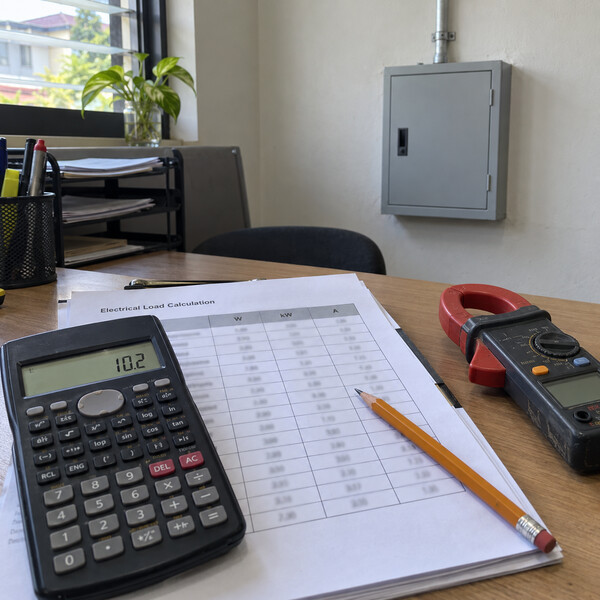
Electrical load calculations help estimate the amount of power required when lights, air conditioners, water heaters, kitchen appliances, computers, machinery, EV chargers and other equipment are in use.
This calculation can be applied to houses, shops, offices and commercial premises. However, the total wattage of all equipment should not immediately be treated as the maximum usage because most equipment does not operate simultaneously at all times.
📲 Need to upgrade your electrical supply? WhatsApp us for the service.
What Is Electrical Load?
Electrical load is the total amount of power required by electrical equipment and circuits within an installation.
The power rating of electrical equipment is normally stated in watts (W) or kilowatts (kW). This information can be found on the specification label, in the user manual or in the information provided by the manufacturer.
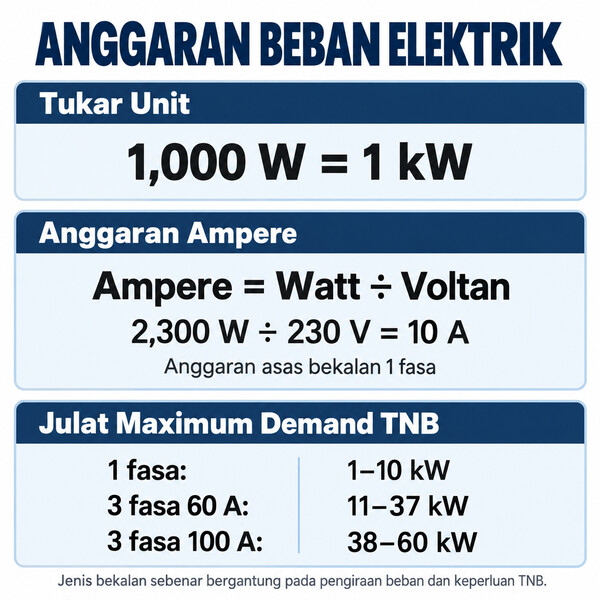
- 1,000 watts equals 1 kilowatt
- 2,000 watts equals 2 kilowatts
- 5,000 watts equals 5 kilowatts
Equipment such as lights, fans and computers generally uses less power. Air conditioners, water heaters, electric kettles, ovens, induction cookers, machinery and EV chargers can place a higher load on the electrical system.
Connected Load and Maximum Demand
Connected load is the total power rating of all equipment connected to an electrical installation.
Maximum Demand is the highest level of electrical demand recorded during a particular period. It is expressed in kilowatts and is used together with load information to determine the required electrical supply capacity.
Maximum Demand is normally lower than the connected load because not all equipment operates simultaneously at its maximum power.
For example, an installation may include several air conditioners, water heaters, kitchen appliances, computers and machinery. However, all this equipment may not operate at the same time throughout the day.
Therefore, an electrical load calculation should consider the type of equipment and its actual usage pattern instead of simply adding together every wattage value.
How to Calculate Electrical Load
For an initial estimate, list the equipment that is normally used at the same time. Then record the power rating of each item in watts or kilowatts.
Example of simultaneous usage:
- Three air conditioners with an estimated combined load of 3.6 kW
- One water heater or other high-powered appliance rated at 3.6 kW
- Kitchen appliances, machinery or socket equipment totalling 2.0 kW
- Lights, fans and computers totalling 1.0 kW
The estimated simultaneous electrical load is:
3.6 kW + 3.6 kW + 2.0 kW + 1.0 kW = 10.2 kW
This example only demonstrates a basic calculation method. The actual power rating of each appliance may vary depending on its model, capacity and usage.
A technical calculation may also consider usage factors, starting current, power factor and equipment characteristics. Therefore, a basic user estimate should not be used directly to determine cable sizes, protective devices or meter types.
How to Convert Watts to Ampere
For a basic single-phase supply estimate, the relationship between watts, voltage and ampere can be explained using the following formula:
Ampere = Watt ÷ Voltage
For example, equipment rated at 2,300 watts on a 230-volt supply uses an estimated current of:
2,300 W ÷ 230 V = 10 A
This formula is suitable as a basic explanation. The actual current used by air conditioners, motors, pumps, machinery and certain equipment can be affected by power factor, efficiency and starting current.
A three-phase supply uses a different formula and calculation method. It also considers phase-to-phase voltage and the power factor of the installation.
How Many kW for a Single-Phase or Three-Phase Meter?
Based on the TNB reference table for meter types and Maximum Demand, the basic ranges are as follows:
| Meter Type | Size | Maximum Demand | Connection |
|---|---|---|---|
| Single phase | - | 1–10 kW | Overhead / Underground |
| Three phase | 60 A | 11–37 kW | Overhead / Underground |
| Three phase | 100 A | 38–60 kW | Underground |
| Three-phase LV CT Meter | Starting from 150/5 A | 61 kW and above | Underground |
Overhead refers to an electrical connection supplied through overhead lines, while underground refers to a connection supplied through underground cables.
These ranges do not mean that a meter size can be selected using only a simple calculation. The actual selection still depends on Maximum Demand, the type of premises, the connection method, the condition of the installation and TNB requirements.
📲 Need an electrical load assessment? WhatsApp us for the service.
When Might a Single-Phase Supply Be Insufficient?
TNB advises domestic users to consider changing from a single-phase to a three-phase supply when the household electrical load exceeds 10 kW or 50 A.
For shops, offices and commercial premises, the type of electrical supply should be determined according to the total load, type of equipment, usage pattern and installation requirements.
Conditions that may increase the electrical load include:
- Several air conditioners operating at the same time
- Using more than one high-powered water heater
- Using an oven or induction cooker
- Installing an EV charger
- Adding computers, machinery, pumps or commercial equipment
- Renovation or additional spaces that increase the number of circuits
A three-phase supply is not necessarily required simply because many appliances are installed. The simultaneous electrical load and the condition of the installation should be assessed first.
To understand the differences between both supply types, read our guide on single-phase and three-phase electrical supply.
Does Frequent Main MCB Tripping Mean the Load Is Too High?
Not necessarily. An MCB or protective device may trip when too many appliances are operating at the same time, but the condition can also be caused by other electrical problems.
Possible causes that should be checked include:
- An overloaded electrical circuit
- Faulty electrical equipment
- Loose or overheated cable connections
- An incorrectly sized protective device
- Improper circuit distribution inside the DB box
- An electrical fault or current leakage within the installation
The actual cause should be identified before deciding to upgrade the electrical supply. Changing to a three-phase supply should not be treated as the automatic solution for every tripping problem.
Why Is an Electrical Installation Inspection Required?
A calculation based only on equipment labels provides an initial estimate. The electrical installation should also be inspected to determine the actual capacity and condition of the system.
Items that may need to be checked include:
- The size and condition of the main cables
- The capacity of the main switch and protective devices
- The circuit arrangement inside the DB box
- The condition of the meter panel
- The earthing system
- The total load used simultaneously
- The requirements of high-powered equipment
If a three-phase supply is required, the meter panel, main cables and DB box may need to be prepared or modified. Further information is available in our guide on preparation before changing from single phase to three phase.
Does the Electricity Bill Show the Maximum Electrical Load?
No. An electricity bill shows the total amount of energy used in kilowatt-hours or kWh during the billing period.
Electrical load in kW represents the rate of power being used at a particular time. High monthly electricity usage does not necessarily mean that the simultaneous electrical demand is also too high.
On the other hand, several high-powered appliances operating at the same time can create a high electrical load even when the total monthly consumption is not particularly high.
Therefore, the electricity bill alone should not be used to determine whether the electrical supply needs to be changed to three phase.
Frequently Asked Questions
How many kW are suitable for a single-phase meter?
Based on the TNB reference range, a single-phase meter is used for a Maximum Demand between 1 and 10 kW. The actual electrical supply type still depends on the load calculation and condition of the installation.
Does a load above 10 kW require a three-phase supply?
TNB advises changing to a three-phase supply when the household electrical load exceeds 10 kW or 50 A. For shops, offices and commercial premises, the actual requirement should be assessed according to the load and type of installation.
Can the wattage of all electrical equipment be added together?
The total wattage can be used to determine the connected load. However, this value may not be the same as the Maximum Demand because not all equipment operates simultaneously.
Does an EV charger require a three-phase supply?
Not necessarily. It depends on the EV charger capacity, the total electrical load and the available capacity of the existing electrical supply.
Who can determine whether the electrical supply needs to be upgraded?
The electrical load and condition of the installation should be assessed by a registered electrical contractor with qualifications appropriate to the scope of work.
Need TNB Meter Upgrade Services?
If electricity usage is increasing, the total load, meter panel, main cables and DB box should be inspected before changing the electrical supply.
For electrical work and supply conversion arrangements, refer to our TNB meter upgrade service.
📲 WhatsApp us for TNB meter upgrade services.